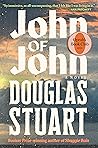
 John of John
by
Douglas Stuart
My rating:
5 of 5 stars
Rating: 4.75 ★
John of John is a brutal, beautiful little punch to the gut. It follows Cal, a young gay man who’s run out of money at uni and has to move back home to the Isle of Harris, into the house—and orbit—of his father, John, a deeply religious crofter who loves him and hurts him in the same breath. Around them, you get this whole web of island life: Ella, Cal’s iconic, vulgar, half‑Gaelic grandmother; Doll, the friend he left behind; Innes, John’s steady neighbour who sees more than he says; and the shadow of Cal’s mother, Grace, who isn’t there but is everywhere.
The writing is honestly stunning. The Gaelic, the Free Church atmosphere, the crofting, the gossip networks—it’s dense, sometimes a bit of work to follow, but it feels so lived‑in and specific that you just sink into it. Stuart never over‑explains. He lets tiny details, dialogue, and body language do the heavy lifting, and it’s incredibly effective.
What really grabbed me is the parallel between Cal and John. You have Cal’s messy, horny, often darkly funny queer desire on one side, and John’s knotted, terrified inner life on the other, and you see how both are shaped by the same island, the same church, the same shame. John can be controlling and genuinely frightening, but he’s also lonely and broken in ways that feel painfully real. Ella, on the other hand, is just pure chaotic love and practicality, and every scene with her was a highlight for me.
The book is also very clear-eyed about misogyny and religion. The way the men in the church talk about women, police young girls, and use faith to justify cruelty made me genuinely angry at points. It feels disturbingly believable, and Stuart doesn’t flinch away from that.
Emotionally, this is not a comforting read. It’s funny in places, tender in places, and packed with lines I wanted to highlight, but it also left me raw and unsettled. It refuses neat justice or a soothing ending. I admire it a lot, even as the final stretch made me want to scream.
If you want a tidy, feel‑good story, this probably isn’t it. If you’re in the mood for something beautifully written, queer, angry, and painfully human, John of John is absolutely worth it.
Thank you to NetGalley and Grove Press for providing an advance copy of John of John by Douglas Stuart in exchange for an honest review.Spoiler section(view spoiler)[
One of the things that hit me hardest was how the book reframes Grace. Cal grows up believing his mother basically abandoned him. When the truth finally comes into focus—that she left because of John, and because the whole system around them gave her no real way to stay without losing herself—it completely shifts the emotional centre of the story. It doesn’t “fix” anything, but it makes her absence make sense in a way that hurts.
(hide spoiler)](view spoiler)[
John and Innes absolutely wrecked me. Those scenes in Innes’s house, John checking every room to be sure they’re alone, the way he’s torn between wanting to go upstairs and wanting to flee—it’s brutal. When Innes finally says, “If I’m for hell, then I deserve a love that was worth it,” it’s such a clean, devastating line. It’s one of the few moments where someone actually says out loud what all of this has cost them.
(hide spoiler)](view spoiler)[
On Cal’s side, the sexuality is so much messier and more physical. The letters to Billy, the “nice thighs” comment, the absolutely unhinged (and kind of hilarious) penis drawing with watercolour and spit—it’s funny and gross and also weirdly sad. When Billy sends back essentially a polite rejection, it stings more because we never really got to see that connection build; it’s over almost as soon as it starts.
(hide spoiler)](view spoiler)[
The Doll storyline is another knife. Cal lying about diarrhoea to dodge a sexual situation, then going home to pray for forgiveness, and later waiting until Doll is drunk enough for touching—it’s such a clear picture of what shame does to people. You can see how Cal has inherited John’s patterns, just in a newer generation.
(hide spoiler)](view spoiler)[
Ella trying to sort out the croft so Grace and Cal might actually have a way out is one of the most moving parts of the book for me. It’s very her: practical, sneaky, and done out of love. She’s trying to carve out a future that isn’t controlled by John, and you can feel how much thought and risk that takes.
(hide spoiler)](view spoiler)[
Which is exactly why the ending hurts so much. John finds out and basically wins. He keeps the croft; he keeps the status. In those last pages he’s almost euphoric, talking about how they can go on, just the two of them, as if nothing has changed. From his perspective, it’s a victory. From Cal’s, it’s a trap closing. The “resolution” is that he sees clearly how stuck he is. There’s no big downfall for John, no collapse of the system—just a sharper understanding of it.
(hide spoiler)](view spoiler)[
The church stuff near the end made me furious. The way the elders talk about Isla, twist her situation, and basically weaponise her against other people is disgusting and way too believable. It’s misogyny and religious cruelty dressed up as concern for souls, and Stuart nails the tone a bit too well—I was genuinely outraged reading those scenes.
(hide spoiler)](view spoiler)[
John’s confession to the city priest is an interesting contrast. There’s this tiny glimpse of a softer, more humane kind of faith, someone who actually listens and isn’t trying to control him, but John can’t take that path. He walks straight back into the punitive version he knows, and that choice is a big part of why things end the way they do.
(hide spoiler)](view spoiler)[
By the time we get to the final conversations between Cal and John, it’s almost unbearable. John tries to claim he’s always known about Cal and that it doesn’t change his love, but it’s too little, too late, and too coloured by everything he’s done. Ella’s “Make yourself happy, son. Christ above, let one of us be,” feels like the real closing line of the book. There’s no neat freedom on the page, but there is that wish hanging there.
(hide spoiler)](view spoiler)[
That’s why I ended up at 4.75 stars. As a piece of writing, it’s incredible. As an emotional experience, it’s honest in a way that’s almost unbearable. It doesn’t give you the justice you want, but it absolutely gives you the truth. In a sense, I felt questions was too intetionally left unanswered.
(hide spoiler)]
View all my reviews


Comments
Post a Comment